

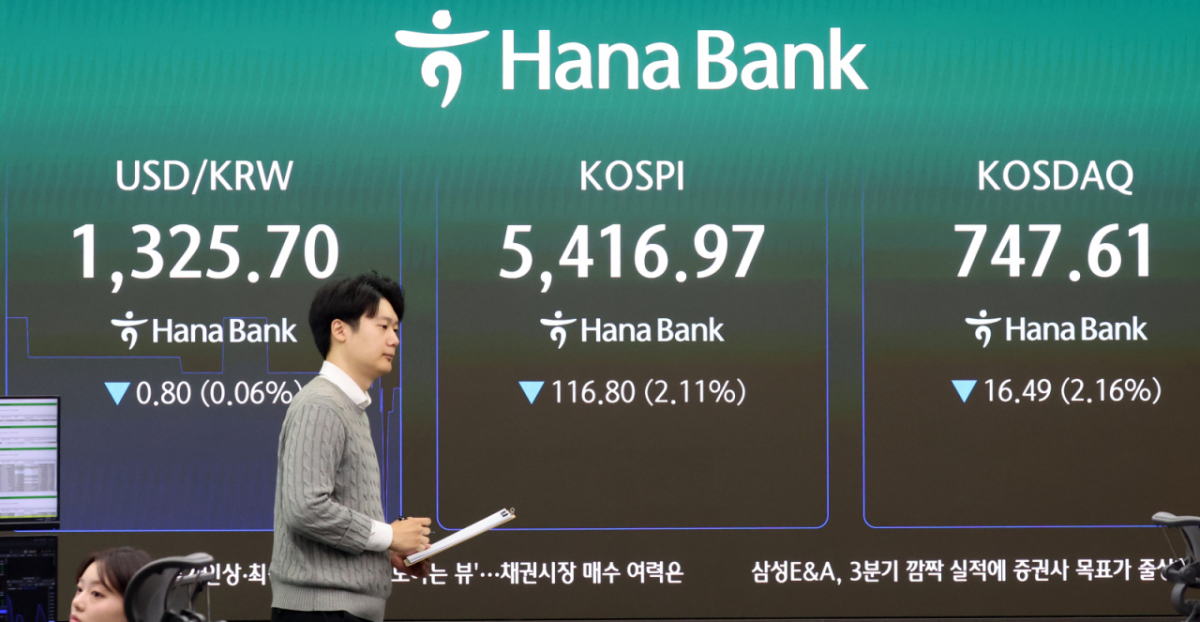
Amid persistent concerns over the profitability of AI (artificial intelligence), the KOSPI has fallen to the 5,300 level. The re-emergence of U.S.-Iran tensions and the resulting surge in international oil prices also negatively impacted investor sentiment. While declines continue among domestic semiconductor stocks, SK Hynix is attempting a rebound following the withdrawal of Solidigm's IPO (dual listing).
According to the Korea Exchange on the 23rd, as of 11:24 a.m., the KOSPI was trading at 5339.40, down 134.37 points (2.43%) from the previous trading day. The KOSPI index showed a decline of 1% to 3% in the early session, dropping as low as 5305.98. As of intraday levels, this is the first time since July 29 that the KOSPI index has fallen below the 5,400 mark.
Industry experts pointed to concerns over AI profitability raised following Meta's earnings report last night as a cause for the KOSPI's weakness on this day. Meta's large-scale AI investment plans triggered concerns regarding funding burdens and profitability. Additionally, investor sentiment was dampened as geopolitical tensions resurfaced and international oil prices spiked.
On the 22nd (local time), the NASDAQ Composite Index closed at 26,008.86, down 2.6% from the previous trading day. The S&P 500 Index fell 1.21% to 7663.43, while the Dow Jones Industrial Average rose 0.02% to 52,867.98. The Philadelphia Semiconductor Index plunged 7% during intraday trading.
Meta's third-quarter cash flow recorded a deficit of minus $2.12 billion, a reversal from the previous quarter ($780 million). Although both revenue and EPS (earnings per share) were favorable, deteriorating cash flow sparked concerns over whether funding for large-scale AI infrastructure investment would be possible. Meta's stock price fell by approximately 7% on this day. Major semiconductor stocks, including Nvidia, AMD, and Micron, declined in tandem, while AI cloud company CoreWeave also dropped by about 10%.
Han Ji-young, a researcher at Kiwoom Securities, forecasted, "It will open lower due to the correction in U.S. AI stocks following concerns over Meta's credit instability, oil price burdens, and other factors." However, she added, "Considering that the negative news from Meta has already been partially reflected in the domestic stock market on the previous day, and that oversold conditions are valid, it is expected to show a trend of recovering intraday losses while absorbing panic selling in the early session."
However, SK Hynix showed a lower decline rate compared to Samsung Electronics and even rose by over 1%. Samsung Electronics was trading at 207,500 won, down 3.26% from the previous trading day, while SK Hynix was trading at 1,216,000 won, down 0.57%. Before the opening of trading on this day, SK Hynix announced that it would halt its consideration of Solidigm's IPO (initial public offering) and pre-IPO promotion. It is interpreted that the stock price, which had been weighed down by concerns that Solidigm's IPO could erode SK Hynix's shareholder value, has begun to rebound following the withdrawal of the listing. However, it is argued that this is merely a short-term factor reversing the decline, and demonstrating the sustainability of the memory semiconductor profit cycle is necessary for a trend-based rebound.
SK Hynix stated, "This is not because Solidigm's growth potential or investment necessity has changed," adding, "Considering recent capital market conditions and stock price trends, we determined that it was necessary to re-examine whether an IPO at this time would be the most advantageous choice for SK Hynix and existing shareholders."
A researcher at a securities firm who requested anonymity explained, "The perception spread that Solidigm's IPO involved unnecessarily splitting up a healthy company and listing it, which negatively impacted the stock price," adding, "It acted as negative news by adding a variable completely unrelated to the AI profitability discussed so far."
Opinions also emerge that macroeconomic uncertainty must be resolved for the dampened investor sentiment pervading the entire KOSPI market to recover. On the 22nd (local time), Brent crude futures closed at $113.17 per barrel, up 4% from the previous day, while West Texas Intermediate (WTI) crude oil rose 2.39% to close at $99.47. This followed reports that the U.S. and Israel could conduct additional airstrikes on Iran amid fierce attacks by Yemen's pro-Iran Houthi rebels against Saudi Arabia, leading to energy supply instability.
Lee Sang-yeon, a researcher at Shin Young Securities, stated, "As long as international oil prices fluctuate around $100, it appears difficult for the stock market to rise in a trend-based manner," adding, "For international oil prices to settle significantly, a conclusion ending the war must emerge in some direction, and this will likely depend on the midterm elections."

 in STOCK
